More Than a Viral Video
Summer 2026 Issue
![]() More Than a Viral Video
More Than a Viral Video
By Karen B. Moore, Contributing Writer
The Wolf, the Trap, and the Longstanding Relationships Behind a Scientific Breakthrough
The first recorded instance of wolves using tools to raid a crab trap may have propelled Dr. Kyle Artelle into international headlines, but his relationship with these animals stretches far deeper than a single viral moment. Long before the footage circulated, he had been immersed in the complex, often surprising world of wolf behavior, and his work continues to reshape how we understand the species.
Last year, while conducting research in support of the Haíɫzaqz Nation’s invasive green crab control program in their Territory on the central Pacific coast of British Columbia, Canada, Artelle and his fellow researchers were trying to help determine who had been damaging crab traps – damage that Haíɫzaqv Guardians had been noticing for months. Although the damage looked like it could have been done by bears or wolves, some traps were set in water so deep they were never exposed, even on the lowest tides, suggesting a marine mammal might be the culprit. Almost on a whim, the group repurposed a camera from a separate wolf study and positioned it at the site to see if they could uncover any clues as to “whodunit.” Even with their extensive knowledge of wolf behavior, the researchers were caught off guard by what they witnessed.
“The wolves were the last thing on our list that we thought we’d see,” Artelle said. “We thought maybe we’d see a seal swim by, maybe an otter, but wow! Certainly, seeing a wolf pulling that trap out of the water was not what we expected.”
The camera captured a remarkable sequence: a wolf swimming with a floating buoy in her mouth, which was attached to a line that in turn was connected to a crab trap. She repeatedly pulled the line until the trap came to the surface, she opened the bait cup within, and helped herself to a snack of bait. The footage raised an immediate question for researchers: how did the wolf locate the trap in the first place? Given the depth of the water and the constant movement of the tides, scent alone seemed an unlikely explanation.
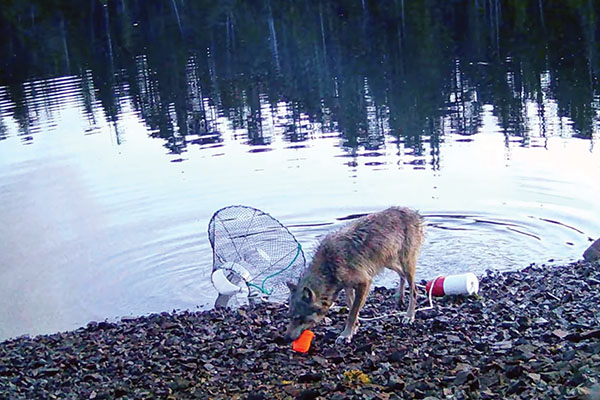
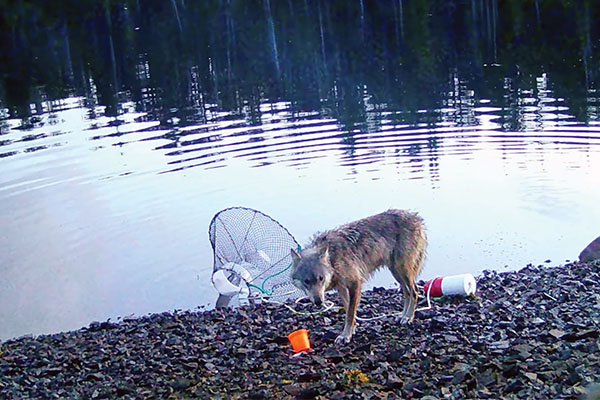
Watching the camera footage, Artelle said it could be that the wolf learned to associate the floating buoy with the trap, and she may have developed the behavior gradually through repeated exposure.
“She very well may have been investigating these traps when they were fully exposed on the beach (during a low tide) … and then step-by-step, ended up pulling them in from deeper and deeper water,” he said. “Alternatively, she might have watched people grabbing the float and then pulling the line of the trap onto the boat and modeled a similar approach. We don’t know.”
What the researchers did know was that they had never documented anything like it before. When they released the footage and their analysis, the discovery quickly captured international attention.
The discovery opens up new lines of inquiry into the cognitive abilities of wolves, particularly their capacity for problem solving and tool use. “One of the things this does is raise questions about … wolves using tools,” Artelle said. The behavior also appears to be specific to certain packs, hinting at a form of cultural learning passed from one generation to the next.
“That pack has learned how to do this and has taught it to one another. Nearby packs haven’t learned it yet. That’s the realm of culture,” he said. Wolves are highly social and capable, “they absolutely teach each other. They communicate,” he said.

“We thought maybe we’d see a seal swim by, maybe an otter, but wow! Certainly, seeing a wolf pulling that trap out of the water was not what we expected.”
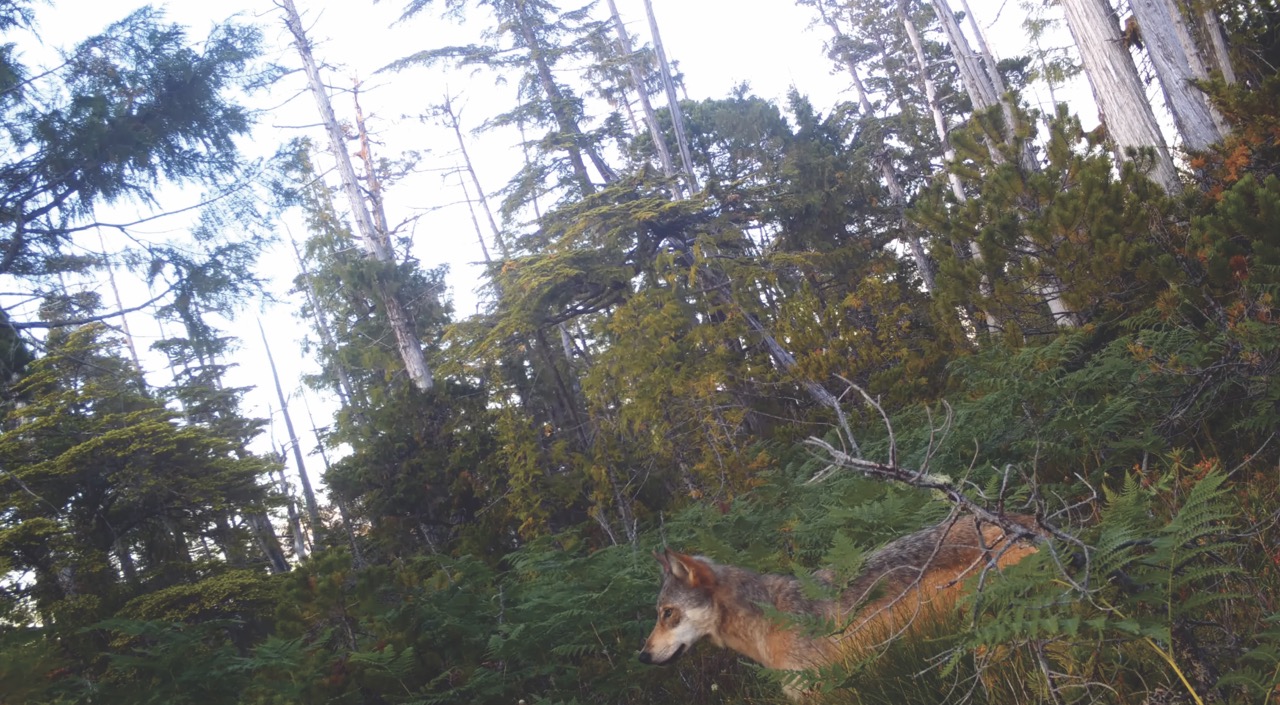
The wolves in this region face minimal human persecution, and early research findings suggest that they may be living longer lives than other global populations. “The wolves in this general area are different from a lot of the rest of the world in that they get to grow old.” This allows for elders to pass along knowledge. Of direct relevance to this particular study, the lack of persecution might have also been part of what supported this behavior’s development: if wolves here are not having to devote as much attention to vigilance - protecting themselves from people - they might feel more comfortable in exploring new behaviors, in trying new things. This ‘Place of Wolves’ might then prove an important benchmark place for understanding the ecology, behavior, and potential for human coexistence of wolves, by learning from them in an area where they’re freer to live out their lives without undue human influence.
Artelle is quick to note that the Indigenous Guardians here were central to the discovery and research. “It wouldn’t have happened if the Guardians weren’t there, if the Nation wasn’t leading the stewardship and research in this area,” he said. “It isn’t ‘scientists discovered X, Y, and Z’. We were lucky enough to be invited to do some of this work building off the work the Nation is leading.”
Artelle collaborates with Indigenous people on many research projects. While the discovery of wolves using tools was made while researching crabs, the ‘Place of Wolves: Haíɫzaqz Wolf and Biodiversity Project’ is an extensive collaboration between the Heiltsuk Integrated Resource Management Department and ESF, which supports the stewardship of wolves through a minimally invasive research and monitoring program.
“This is an example of the work that the Center does,” he said. “It’s very much the Nations taking the lead, and then us finding ways to support that work.”
The project team is composed of researchers, Haíɫzaqv Guardians, and other collaborators, coordinated by Artelle, William Housty (Heiltsuk Integrated Resource Management Department), and Paul Paquet (University of Victoria).
Along with being an assistant professor in the Department of Environmental Biology, Artelle is also Faculty co-director at ESF’s Center for Native Peoples and the Environment (CNPE). He notes that this research, including the recent wolf work, reflects the Center approach of working closely with Indigenous Nations.
“This is an example of the work that the Center does,” he said. “It’s very much the Nations taking the lead, and then us finding ways to support that work.”
At ESF, Artelle teaches Indigenous Issues in the Environment, a survey course originally developed by Dr. Robin Kimmerer ’75, the founder of the CNPE. The class invites students to examine the multi-faceted dimensions in which Indigenous lands, peoples, and knowledges are connected to the environment. Through introduction to Indigenous worldviews, case studies, and contemporary environmental contexts, students explore how knowledge systems intersect with policy, stewardship, and community relationships. It’s a course that not only broadens their understanding of environmental science, but also asks them to consider their responsibilities within it.
Often when considering environmental problems, Artelle said, “We sort of have our blinders on and we focus on what a given environmental issue looks like in relation to New York state law, to mainstream environmental thinking and practices, and not the Indigenous context of whose land is it on in the first place? What is the history of the land? What is the history of relationships of people with the land? What other knowledges and people have been ignored or suppressed?”
“This class is very much designed to give insights into things like Indigenous knowledge, treaty rights, the history of here, and this continent.”
Artelle also introduced a course during the fall 2025 semester that takes a solutions-oriented view of the environmental landscape, Bright Spots and Conservation.
Students examine conservation bright spots at multiple scales ranging from ESF, to the Onondaga Nation and the broader Haudenosaunee Confederacy, to events happening across the globe, looking at conservation efforts whose outcomes are “disproportionately successful.”
“We ask, where is it really, really working?” Artelle said. For example, students pointed to research from Kenya showing that elephants avoid small‑scale farms protected by beehive fences up to 86% of the time during peak crop seasons, reducing human–elephant conflict and increasing farmers’ income.
The class analyzed real‑world case studies, identified the conditions that allow conservation “bright spots” to emerge, and considered how those principles might guide their own choices and work. “Whatever they do next, how can they cultivate some of these bright spots in their own work?” Artelle asked.
This emphasis on applying research to real-world impact is also what makes Artelle a compelling storyteller beyond the classroom. This fall he will be the featured speaker at the Dale L. Travis Lecture series, presenting: Haíɫzaqz Wolf and Biodiversity Project – learning from, and about, the Place of Wolves.
Learn more about the lecture by visiting www.esf.edu/travislecture/.
Segments of this article were adapted from the “Meet the Faculty” spotlight produced by Gavin Ellis in the ESF Office of Marketing.
Photo credits: Tévan Wilson at Dúqvḷá Media, Kyle Artelle, and placeofwolves.ca